
| Site type | Residential property, driveway above kitchen |
|---|---|
| Sector | Residential |
| Challenge | Rainfall-related water damage across the kitchen ceiling |
| Solution | Thermal, moisture, tracer gas and flood testing |
| Result | Doorframe ingress identified; flood testing reproduced water escape through the ceiling |
The Challenge
The policyholder reported kitchen ceiling water damage linked to rainfall. With the driveway above the kitchen, SOS Leak Detection was appointed to investigate the reported ingress.
Visible internal pipework showed no observable issues, and the exterior inspection revealed no clear defects. SOS continued with thermal imaging, moisture readings and tracer gas testing in the ceiling void.
Key Challenges
- Rainfall linked to kitchen ceiling damage
- A driveway directly above the kitchen
- No clear defects on exterior inspection
- No visible issues with exposed pipework
- Tracing ingress through the ceiling void
The Solution
SOS combined visual inspection with thermal imaging and moisture testing to assess the affected ceiling.
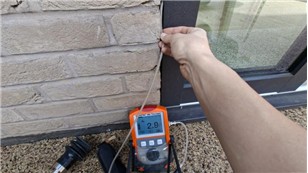
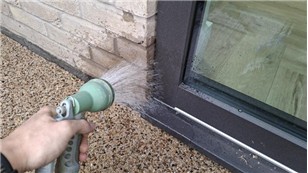
Tracer gas testing in the ceiling void then located an escape point around the doorframe. A targeted flood test reproduced water ingress through the kitchen ceiling.
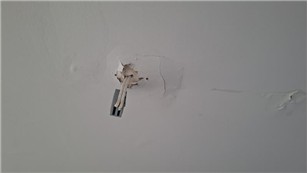
Visual inspection: Visual checks confirmed ceiling damage. No issues were visible on the internal pipework, and the exterior inspection revealed no clear defects.
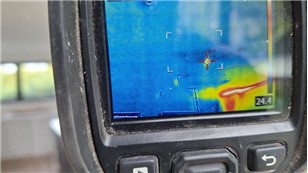
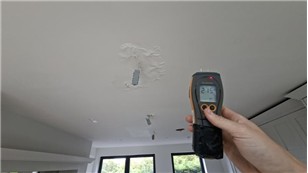
Thermal and moisture checks: Thermal imaging revealed a significant cooling anomaly. Moisture meter testing recorded raised ceiling readings of up to 999 REL.
Tracing the escape point: SOS introduced tracer gas at low pressure into the ceiling void beneath the driveway for two hours. Gas escaped around the doorframe.
Reproducing the ingress: SOS flood tested the doorframe and observed water escaping through the kitchen ceiling, reproducing the reported ingress.
The Results
The investigation attributed the problem to rainwater ingress around the doorframe. Flood testing reproduced the route into the kitchen ceiling. The report recommended an approved glazing contractor to inspect the affected glazing and carry out necessary repairs, followed by an approved building contractor to repair and reinstate the damaged areas.
- Significant cooling anomaly identified on the ceiling
- Ceiling moisture readings reached 999 REL
- Tracer gas testing ran for two hours in the ceiling void
- Gas escape located around the doorframe
- Flood testing reproduced water ingress through the ceiling
- Glazing repairs recommended before internal reinstatement
Why SOS Leak Detection?
SOS combined complementary tests to trace the rainwater ingress. Thermal imaging and moisture readings documented the affected ceiling. Tracer gas located an escape point, and flood testing reproduced water ingress before the report set out the repair sequence.
-
Evidence at the ceiling
Thermal imaging found a cooling anomaly and moisture readings reached 999 REL. -
Testing the hidden void
Tracer gas testing continued for two hours beneath the driveway. -
Targeted investigation
Gas escape around the doorframe directed the subsequent flood test. -
Visible confirmation
Flood testing reproduced water escape through the kitchen ceiling. -
Clear repair sequence
An approved glazing contractor should repair the glazing before internal reinstatement.
Contact Your Leak Detection Specialists Today
"*" indicates required fields